

KEY RESOURCE
2025 Gartner® Magic Quadrant™ for Data Integration Tools
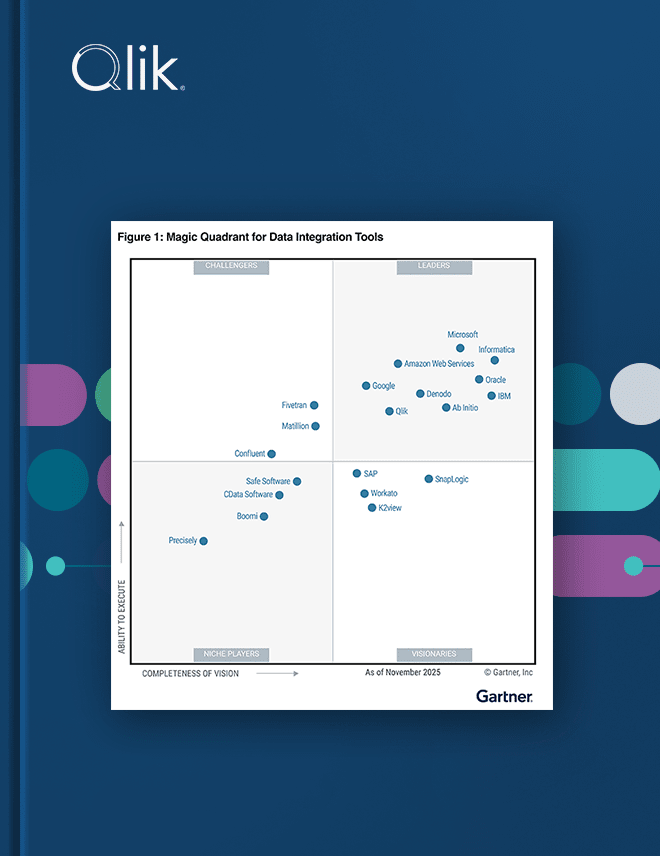
For the 10th consecutive year, Qlik was recognized as a Leader in the 2025 Gartner® Magic Quadrant™ for Data Integration Tools. Learn why in this complimentary report.

Make data universally available
Replicate, synchronize, distribute, consolidate, and ingest data across all major databases, data warehouses, and Hadoop, on-premises and in the cloud. For example:
A global insurer cut its nightly batch load time from 6–8 hours to fewer than 10 minutes
A large credit services organization applied 14 million source changes to the target in 30 seconds

Accelerate data integration for analytics
Quickly and easily set up data replication with an intuitive GUI and eliminate the need for manual coding.
Simplify massive ingestion into Big Data platforms from thousands of sources
Automatically generate target schemas based on source metadata
Efficiently process big data loads with parallel threading
Use change data capture process (CDC) to maintain true real-time analytics with less overhead


Accelerate your data pipeline
Integrate data across all major platforms
Load, ingest, migrate, distribute, consolidate and synchronize data on-premises and across cloud or hybrid environments. These include:
RDBMS: Oracle, SQL, DB2, MySQL, Sybase, PostgreSQL
Data warehouses: Azure Synapse, Snowflake, Exadata, Teradata, IBM Netezza, Vertica, Pivotal
Cloud Platforms: AWS, Azure, Google Cloud
Cloud Service Platforms: Databricks, Snowflake, Confluent
Streaming platforms: Apache Kafka, Confluent, Azure Event hubs, AWS Kinesis
Enterprise Applications: SAP, Salesforce
Mainframe: IMS/DB, DB2 z/OS, RMS, VSAM
Please refer to the support matrix for a complete list of connectivity options.


Without Qlik, we could not have done the project since it would have been too costly for us in terms of development work.

After weeks of manual attempts, we turned to Qlik for Amazon Redshift. In less than an hour, Qlik loaded 37 million records.

Qlik Replicate has fulfilled all our expectations and it has been working flawlessly from day one.


By using Qlik Replicate, we’ve been able to rapidly speed up the delivery of data for various use cases.

Maximize data agility with
powerful data replication software
Get a versatile platform for change data capture
Low impact, real-time CDC for many database systems, gives you flexible options to process captured data changes:
Transactional: Apply transactions in the order they were committed to the source to ensure strict referential integrity and lowest latency
Batch optimized: Group transactions into batches to optimize data ingestion and merging into data warehouses, and many targets on-premises or in the cloud
Data warehouse optimized: Load with native performance optimized APIs for Snowflake®, Azure Synapse, and other EDWs that use massively parallel processing (MPP)
Message oriented data streaming: Capture and stream data change records into message broker systems like Apache® Kafka®

Generate high performance at scale
Support one of the broadest ranges of sources and targets. You can load, ingest, migrate, distribute, consolidate, and synchronize data on-premises and across cloud or hybrid environments.
High throughput and low latency: Move data across the enterprise or hybrid environments at high speed to meet real time business requirements
Massive scale: Replicate your data across hundreds of sources and targets
Low impact: Log based, zero footprint technology minimizes data source and target performance overhead
Centralized monitoring and control: Leverage a single interface to create data endpoints, design and execute replication tasks
Monitor thousands of tasks through a single console with user defined alerts and KPIs

Enable SAP analytics
Get SAP application data in real time for big data analytics.
Flexibility: Move the right SAP application data to any major database, data warehouse or Hadoop, on-premises or in the cloud.
Easy data access: Capture and translate complex SAP formats, then export data with an intuitive and automated interface that is purpose built for the SAP environment
Real-time integration: Ingest live SAP data for real-time analytics in data lakes or other targets; create live Kafka messages for streaming analytics

Optimize data movement for cloud native environments
Enable full hybrid mobility: Move data across, into, and off all major cloud platforms and cloud service providers
Enable high performance: Efficiently compress and transfer data in multiple paths over the wide area network (WAN)
Secure data transfer: Leverage advanced, NSA approved (AES-256) encryption.


Get a cloud and analytics vendor agnostic data integration platform
You have maximum choice and deployment flexibility when deciding where to store, transform and analyze your data.
Qlik Cloud Data Integration – A Qlik managed Enterprise Integration Platform as a Service (eiPaaS)
Qlik Data Integration – A client managed solution that can be installed on-premises or as a virtual machine image in any location you choose

Deploy powerful solutions with
end-to-end data replication software


Frequently Asked Questions (FAQs)
Log-based change data capture is a method of capturing data changes by reading a database's transaction log — the internal record the database keeps of every insert, update, and delete. Because it reads this existing log rather than querying the tables directly, it captures every change in order with very little impact on the source system's performance. This makes it the preferred, most efficient approach for real-time replication and streaming, especially at high volumes.
Agentless replication captures and moves data changes without installing any software agent on the source or target systems. Often called zero-footprint, it typically works by reading the database transaction log remotely, avoiding the overhead, maintenance, and risk that source-installed agents introduce. This keeps the performance impact on production systems minimal and makes the solution easier to deploy and manage across many endpoints.
Database replication is the process of copying and maintaining database objects — such as tables and their data — in more than one database, keeping them consistent as changes occur. It's used to improve availability, distribute load, support disaster recovery, and feed analytics systems with current data. It can be one-way or two-way and, with change data capture, can keep replicas updated in near real time.
Data consolidation is the process of combining data from multiple separate sources into a single, unified location — such as a data warehouse or lake — to create one comprehensive view. It reduces silos and gives analysts and applications a single place to work with data that once lived in many systems. Replication and ingestion tools are commonly used to continuously feed and keep a consolidated store up to date.
Data migration is the one-time process of moving data from one system, storage, or environment to another — for example, from an on-premises database to the cloud. It typically involves extracting data from the source, transforming it to fit the target, and loading it, all while ensuring accuracy and completeness. Careful planning, validation, and often replication techniques are used to migrate with minimal disruption and no data loss.
Zero-downtime migration is an approach to moving data or systems without taking the source offline or interrupting the business during the switch. It typically works by first copying the existing data to the new system, then using change data capture to keep the new system continuously in sync with the old one until the moment of cutover. This lets organizations migrate critical systems without the outage a traditional migration would require.
Data replication is the process of copying data from a source to one or more targets and keeping those copies current as the source changes — supporting operations like synchronizing, distributing, and consolidating data. Modern tools can replicate across a broad range of systems — databases, warehouses, mainframes, and cloud platforms — from almost any source to any target. Using real-time change data capture and a no-code interface, they keep targets continuously up to date without heavy manual effort.
Data synchronization is the process of keeping data consistent across two or more systems so that a change in one is reflected in the others. It can be one-directional, updating a target from a source, or bidirectional, keeping both sides mutually current, and it can run continuously or on a schedule. Synchronization keeps distributed systems, databases, and applications aligned so everyone works from the same, current data.
Data ingestion is the process of bringing data from many source systems into a central platform — such as a data warehouse, lake, or streaming system — where it can be stored and used. It can run in batch, loading data in scheduled chunks, or in real time, capturing changes as they happen. Efficient ingestion at scale often relies on change data capture and parallel processing to handle large volumes from many sources at once.
Replication is commonly categorized by method and by timing. By method, full or snapshot replication copies an entire dataset, incremental replication moves only records changed since the last run, and log-based change data capture streams every change as it happens. By timing it can be real-time and continuous or scheduled, and by direction it can be one-way or two-way. Most enterprise setups pair an initial full load with ongoing CDC to balance completeness and efficiency.
Data migration is a one-time move of data from one system to another, usually during a platform change or cloud move, after which the original source is retired. Data replication is ongoing — it keeps a live copy continuously in sync with a source that stays in use, so both remain current over time. The two connect in practice: replication is often used to carry out a migration with little or no downtime, keeping the new system updated until the final cutover.
