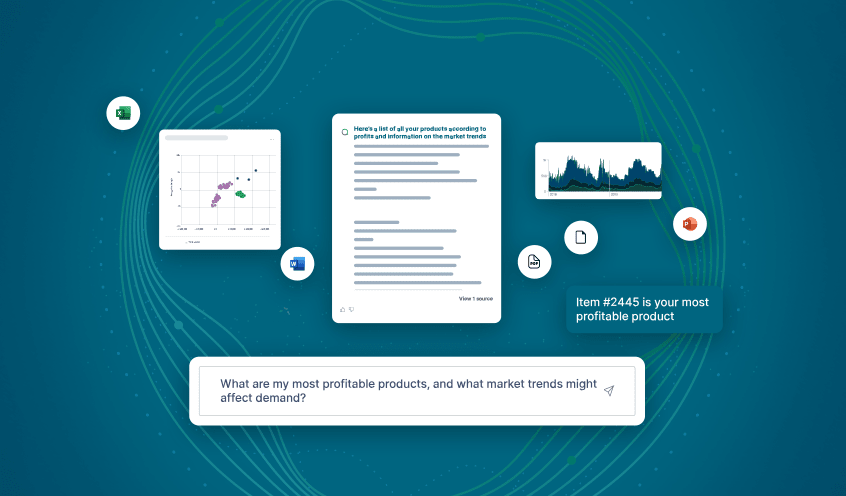
YOUR AGENTIC AI ASSISTANT
Transform Decision Making and Action with Qlik Answers®
Deliver unprecedented insight from your data and peak productivity from your people.

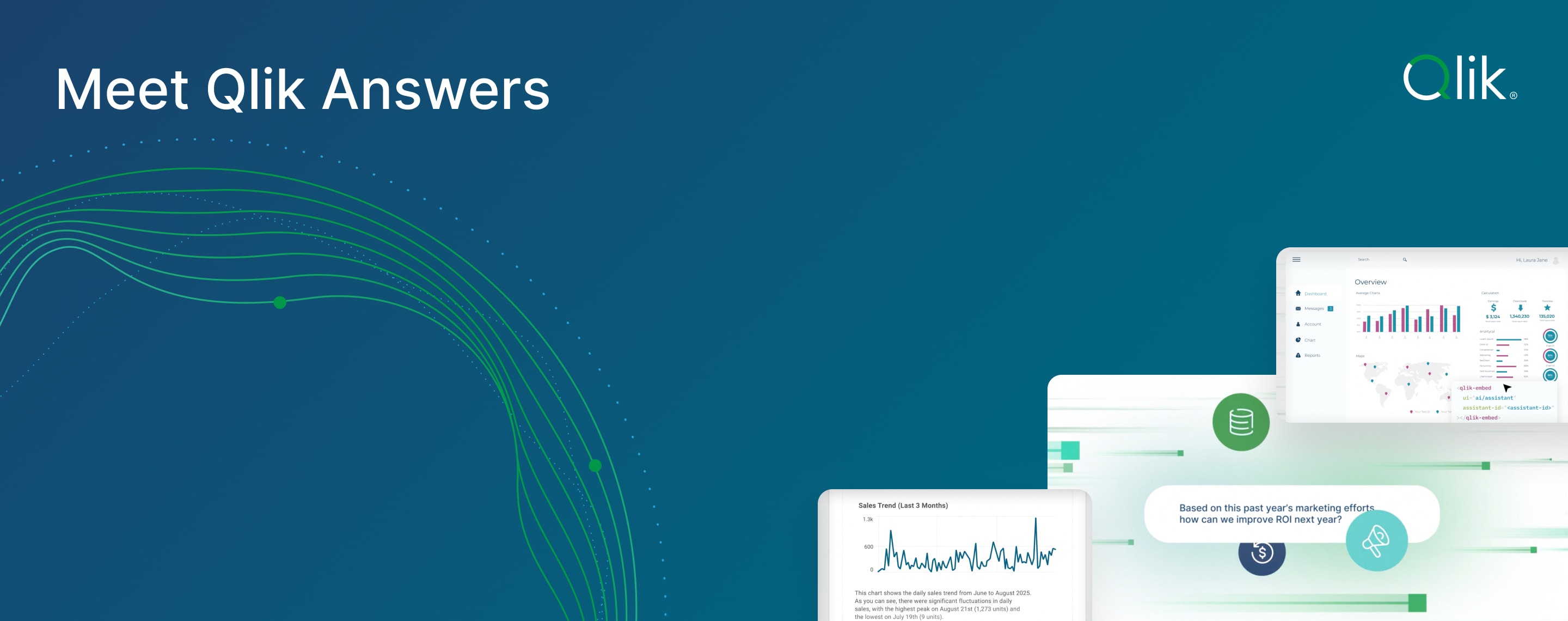
Change How You Work through AI
Meet Qlik Answers — your natural language AI assistant that helps you make better decisions and be more productive using all your trusted data.
Get Answers
Qlik Answers combines the unique power of the Qlik analytics engine with world-class LLMs to deliver a complete and contextually relevant insights from your analytics and unstructured content, with full explainability and trust.

Boost Output
Empower Qlik users and developers with personalized help and assistance across the Qlik platform, and automate tasks and workflows for enhanced efficiency.

Fast Time to Value
Get up and running in hours, not months, with fast plug-and-play deployment built on Qlik’s cutting-edge agentic AI architecture.

THE STATE OF AGENTIC
The State of Agentic AI is Here
79% of enterprise leaders say agentic AI is critical to their strategy, yet only 18% have fully deployed it. Find out what's standing in the way (and how to fix it).

Why Qlik Answers Stands Apart
Unlock game-changing insights
Put all your data to work
Combine analytics, unstructured data, and knowledge from LLMs to generate the most complete and relevant answers.
Explore and follow your thought
Ask follow up questions and follow your chain of thought, with contextual analytics from the Qlik engine and powerful agentic reasoning from LLMs.
Ensure trust through transparency
Full explainability into analytical reasoning and citations for unstructured content ensure confidence in every answer.

A new Agentic AI experience
Complex, multi-step reasoning
Break down and execute complex questions using agentic reasoning with increasing autonomy.
A game-changing engine
Leverage Qlik’s unique analytics engine for super-fast, cost-efficient calculations and deeper insights.
Plug-and-play deployment
Get started in under an hour — easy to configure, fast time-to-value.

AI POTENTIAL
Unlock AI’s Full Potential

The power of data at your fingertips
Make better decisions faster with personalized, AI-generated answers.
Deliver insight to far more people through natural language interaction.
Combine your analytics and unstructured data with knowledge from LLMs.

Personalized support when you need it
Get answers from help content based on where you are and what you’re doing.
Automate developer tasks using natural language.
Empower business users with guidance to improve insight and adoption.

Create standalone AI assistants with ease
Build assistants through a simple, accessible workflow.
Add analytics apps and unstructured content in knowledge bases.
Easily embed assistants in operational apps for answers where you work.
Frequently Asked Questions (FAQs)
An AI assistant is a software application that uses artificial intelligence (typically natural language processing and large language models) to help users complete tasks, answer questions, and find information through conversation. It reads a person's intent from plain language and responds in kind, instead of requiring specific commands or query syntax. Enterprise AI assistants go further by drawing on an organization's own data and content to give relevant, context-aware answers.
Unstructured data is information that doesn't follow a predefined format or organized model, such as documents, emails, PDFs, presentations, images, audio, and video. It's estimated to make up the large majority of the data organizations hold, yet it's far harder to search and analyze than neatly organized database records. Getting value from it usually takes AI and natural language processing to interpret its meaning.
Structured data is organized into a defined format (rows and columns in databases or spreadsheets), which makes it easy to store, search, and analyze with traditional tools. Unstructured data, like text documents, images, and audio, has no fixed structure, so it needs AI techniques to interpret and use. A third category, semi-structured data like JSON or XML, falls between the two, carrying some organizational tags without a rigid table format.
Natural language processing (NLP) is a field of artificial intelligence focused on getting computers to understand, interpret, and generate human language. It combines linguistics and machine learning to handle tasks like translation, sentiment analysis, summarization, and answering questions. NLP is the technology that lets people interact with software in everyday language instead of code or rigid commands.
A knowledge base is an organized, centralized repository of information (documents, articles, FAQs, and data) that people or software can draw on to find answers. For AI, a knowledge base provides the trusted source content an assistant searches to ground its responses. Keeping that content accurate and well-organized is what lets an AI assistant return reliable, relevant answers.
Conversational AI refers to technologies that let computers hold human-like dialogue: understanding what a person says, reading their intent, and responding naturally. It combines natural language processing, machine learning, and often large language models to power chatbots and virtual assistants. Unlike a simple scripted bot, conversational AI handles varied phrasing and follow-up questions in a flowing exchange.
Retrieval-augmented generation (RAG) works in two stages: a retrieval step first searches a knowledge source for content relevant to a user's question, then a generation step feeds that content to a language model to compose the answer. This keeps responses anchored to specific source material, which also makes it possible to cite where an answer came from. Because the model draws on retrieved documents rather than memory alone, RAG delivers more accurate, current, and verifiable results.
An AI hallucination is a response that sounds confident and plausible but is actually wrong or invented, because the model generated it from statistical patterns rather than verified facts. In business settings this is a serious risk, since a convincing but wrong answer can lead to poor decisions. Connecting AI to trusted source data and providing citations that show where each answer came from are common ways to reduce hallucinations and let users check what they're told.
Enterprise search is technology that lets employees find and retrieve information from across an organization's many content sources and systems (documents, databases, applications, and intranets) through a single interface. Traditional enterprise search relied on keyword matching, while modern approaches increasingly use AI to understand natural-language questions and rank results by relevance. The goal is to help people quickly locate the right information scattered across a large, fragmented content landscape.